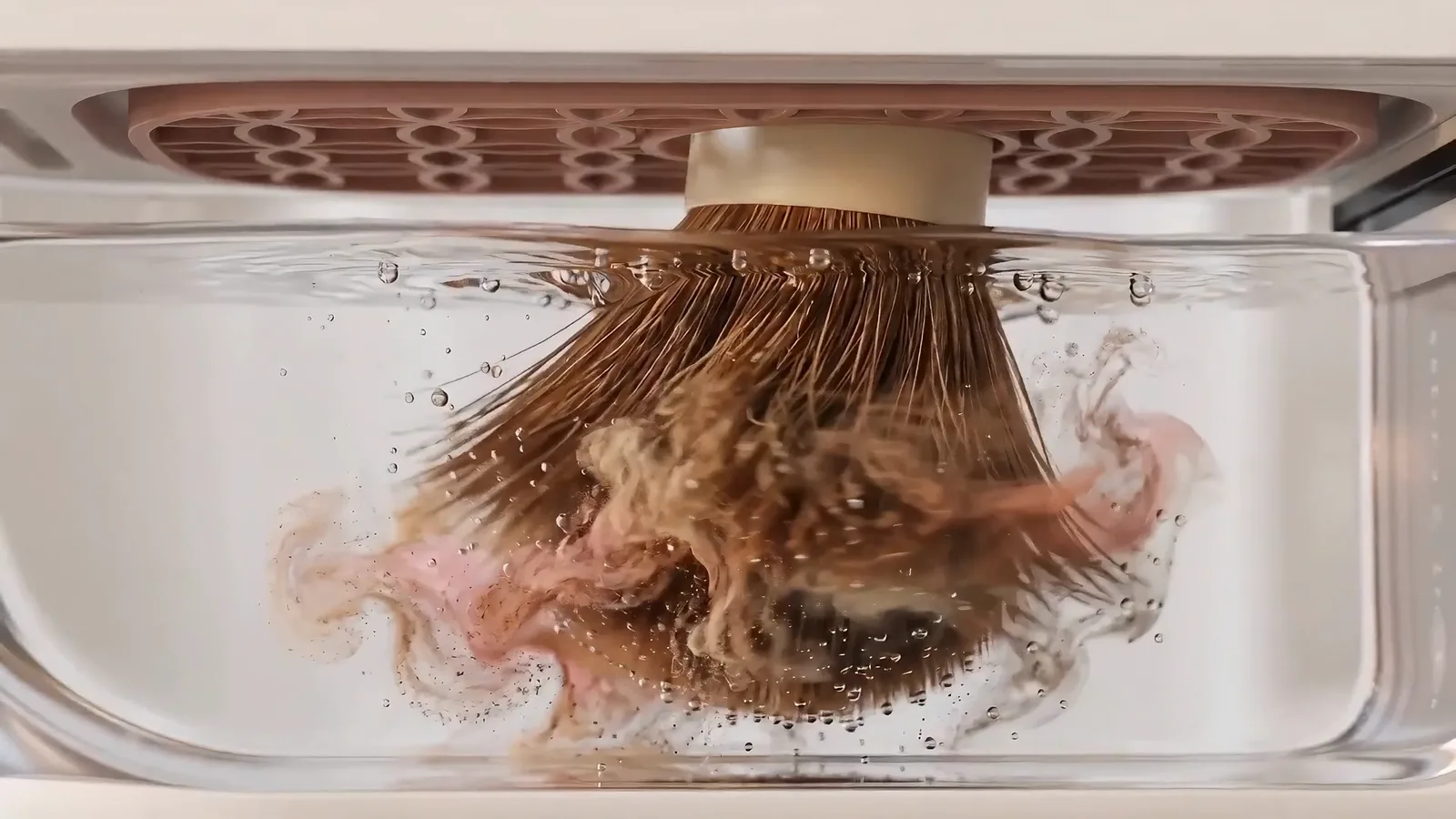
Wash a foundation brush in a hurry and it behaves like any other brush: the water clouds pink, you rinse until it runs clear, the bristles look fine. Then a day or two later the head feels stiff, the base still smells faintly of makeup, and the next application goes on slightly streaky. Foundation did not come out. Most of it never even got wet.
Why foundation is harder to remove than powder
Powder products are mostly pigment and slip — they sit between the bristles without bonding to them, so almost anything that moves water through the head carries them away.
Liquid and cream foundations are built to do the opposite. They are emulsions with film-formers and waxes, designed to spread thin and then set into a flexible layer that survives a full day on skin. On your face that is the point. Inside a brush it means every use coats the bristles in something that sets as it dries — and the place it sets thickest is the root: the dense base where bristles enter the ferrule.
The root is also the one spot a casual wash cannot reach. Bristles are packed tightest there, so water flowing past the tips barely percolates through the base. Whatever hardens at the root stays at the root — the same root residue behind brush odor and patchy application.
The "clear water" illusion
Rinse a used foundation brush and the water turns pink, then beige, then clear. That is the pigment on the tips dissolving away. It is a real signal — of progress in the easiest half of the brush.
What it is not is a signal that the root is clean. A brush can rinse clear, dry fluffy, and still carry a stiff tan layer at its base. Every application after that re-softens a little of it, mixes it with fresh foundation, and presses it back onto your skin — which is one of the quieter reasons makeup starts going on patchy even when the brush looks presentable.
What actually removes it
The variable that matters is not soap strength — it is whether the bristle root physically moves while cleaner is in contact with it.
1. Wet the brush with lukewarm water, bristles pointing down so water never pools in the ferrule. 2. Work cleaner to the base. Mild dish soap or baby shampoo is fine. Squeeze and roll the bristles between your fingers so soap reaches the root, not just the tips. 3. Agitate the root directly. Keep squeezing and rolling the base against your palm until the film breaks up and the lather turns the color of the foundation you have been using. This is the step a swirl skips. 4. Rinse pressing from ferrule to tips, still bristles-down, until no tint comes out at all. 5. Squeeze out water on a towel, reshape the head, and dry it flat with the head off the counter edge — never upright in a cup, where water wicks into the ferrule and loosens the glue.
Different formulas resist to different degrees, and knowing which you are dealing with sets expectations:
| Makeup type | Why it resists washing | What removes it |
|---|---|---|
| Powder blush / bronzer | Pigment sits between bristles, no setting film | Almost any soapy rinse |
| Liquid foundation | Film-formers set into a layer, densest at the root | Cleaner worked to the base plus real root agitation |
| Concealer | Thicker body, same curing film, packs even tighter | Firm squeeze-and-roll at the root, repeated rinses |
| Lipstick / gloss | Waxes and film-formers designed to cling to skin | Oil-friendly soap plus patient root work |
| Mascara | Waxes wrapped around each bristle near the base | Root-level agitation; tips-only swirl leaves the wax |
The pattern in that table: the harder the product is designed to cling, the more the wash has to happen at the root — the one place hand-swirls and moving water both fail.
The pinch test
When you think the brush is clean, verify at the base: pinch the bristle root between your fingers. A truly clean root feels soft and springy, like the brand-new brush it used to be. Stiffness, waxy resistance, or a hard tan core means film is still packed in there, no matter how clear the rinse water ran.
It is a ten-second check that ends the guesswork — the difference between "the water ran clear" and "the brush is clean" is exactly this test.
Where a machine takes over the hard part
Hand-washing works, but step 3 is finger work at the base of every brush, every week — and it is the step most people quietly stop doing. The cleaner we are building at LARKBIRD exists for that step: a percussive mechanism — around 8000 pulses per minute — drives high-frequency impact straight down into the bristle base, breaking up hardened foundation and concealer at the root instead of swirling water around the tips. Drop the brush in, press start, and auto-stop ends the cycle on its own.
It does not excuse the rest of the routine — you still rinse bristles-down and dry flat. But the root-cleaning step, the one foundation makes non-negotiable, stops being the bottleneck.
The bottom line
Foundation sticks because it is engineered to — a curing film that sets densest at the bristle root, exactly where tip-rinsing never reaches. Get cleaner down to the base, move the root while it is in there, rinse bristles-down, and confirm with the pinch test. If you would rather the root-cleaning happened by machine every time, meet the LARKBIRD Brush Cleaner Pro — the rest of our brush-care guides cover the habits that keep brushes performing between washes.
FAQ
Why is my foundation brush still dirty after washing it?
Because the wash only reached the tips. Liquid foundation dries into a film that is densest at the bristle root, where bristles are packed too tightly for water flowing past the tips to flush it out. The water runs clear while the root layer stays — pinch the bristle base and you will feel the stiffness.
Does hot water get foundation out faster?
Not worth the trade. Hot water stresses the glue inside the ferrule and can warp natural bristles, which is a permanent problem versus a temporary cleanliness one. Lukewarm water plus real agitation at the root removes foundation just as well and leaves the brush intact.
Can I use dish soap on a foundation brush?
Yes — a mild dish soap or baby shampoo is a standard choice for liquid and cream makeup. The brand of soap matters far less than where it ends up: it has to be worked down to the bristle base, and the root has to physically move while it is in there.
How do I know when all the foundation is actually out?
Three checks: the rinse water runs fully clear, the bristles feel soft and springy along their whole length, and the pinch test passes — squeeze the bristle root between your fingers and feel for hard, waxy stiffness. If the base still feels packed, the film is still in there.
Do spin brush cleaners get foundation out?
Spinners swirl water around the brush, and moving water cleans surfaces it can reach. The bristle root is exactly where it cannot — the brush stays still inside the flow, so the hardened film at the base survives the cycle. What removes root residue is force applied at the root itself.