Ask around and you will hear that washing makeup brushes is a chore. What actually keeps people from doing it is the other half: the downtime. Wash your foundation brush at 9 p.m. and it is out of service until late the next morning. For most people, that overnight gap — not the fifteen minutes of sudsing — is the real reason brushes go months between washes.
So the drying time is worth knowing precisely, because it is the constraint your cleaning schedule has to fit around.
The short answer
| Brush type | Typical air-dry time |
|---|---|
| Thin eye and brow brushes | 2–4 hours |
| Medium powder and blush brushes | 4–6 hours |
| Dense foundation or kabuki brushes | 6–8 hours, often overnight |
| Natural-hair versions of any of the above | Add roughly 1–2 hours |
The pattern behind the table: drying time follows water retention. Thin synthetic bristles hold almost nothing and dry fast. Dense bristle packing holds water deep at the root, and natural hair absorbs more of it than synthetic fibers, so a natural-hair kabuki is the slowest case on the list.
That root is also the slowest part for a reason that matters: it is the part closest to the ferrule, where water has nowhere to evaporate from and nowhere to drain to unless you position the brush right.
Position matters more than the clock
Two brushes washed at the same moment can finish hours apart depending on how they were left to dry.
- Upright in a cup, bristles up — the worst option, and the most common. Water drains down into the ferrule, the metal collar that holds the bristles. It sits there against the glue for hours. Repeat that over months of washes and the glue weakens; the visible symptom is shedding, with bristles coming off on your face mid-application.
- Flat on a towel — better, but the bristles touching the towel stay damp because moisture is trapped underneath with no airflow.
- Flat with the head hanging off the counter edge — the standard makeup-artist setup. Water drains away from the ferrule and air circulates around the whole bristle head. Reshape the bristles into their natural fan shape first, then rest the handle on the counter with the head over the edge.
- Hanging bristles-down — a brush-drying rack does the same job with gravity actively pulling water out of the ferrule. If you wash frequently, this is the setup worth owning.
One habit fixes most of it before drying even starts: squeeze the water out with a clean microfiber cloth after rinsing, pressing gently from the ferrule toward the tips. That single step removes most of the surface water and cuts hours off the air-dry.
What not to dry brushes with
| Method | What actually happens | Verdict |
|---|---|---|
| Microfiber squeeze | Removes most surface water in seconds | Do it, always |
| Cool fan airflow | Cuts hours off, no risk to brush | Good option |
| Hair dryer on hot | Heat weakens the ferrule glue and stresses bristles | Avoid |
| Radiator or direct sun | Same heat problem, plus handles can warp | Avoid |
| Upright in a cup | Water pools against the glue, causing shedding | Avoid |
The hair dryer deserves a note because it is the most tempting shortcut. The glue bonding bristles to the ferrule is the brush's single fragile point, and it sits exactly where you would aim hot air. Brushes that shed after washing are very often brushes that were heat-dried. If you must use a dryer, cool air at a distance works — but a fan does the same thing without standing there holding it.
Making drying fit your schedule
Once you know the numbers, the scheduling problem has three clean solutions:
- Wash in the evening, use in the morning. Clean brushes right after your last application of the day; even dense foundation brushes are dry by breakfast. This is why makeup artists wash at the end of a workday, never the start.
- Rotate. If you cannot afford a day without a brush, you need two of the brushes you use daily — wash one, use the other. Cheaper than skipping washes.
- Batch on a day off. Wash everything at once on a weekend morning, and by evening the whole collection is back in service.
Notice what these have in common: they all work around a day of drying downtime. That downtime is the hidden cost of every wash, and it compounds. When cleaning a full set means fifteen minutes of scrubbing plus a day of downtime, the interval between washes quietly stretches from a week to a month — and at a month, the case for weekly cleaning is already lost. Dirty-brush skin problems tend to start with the schedule, not with the soap.
Where a machine helps — and where physics wins
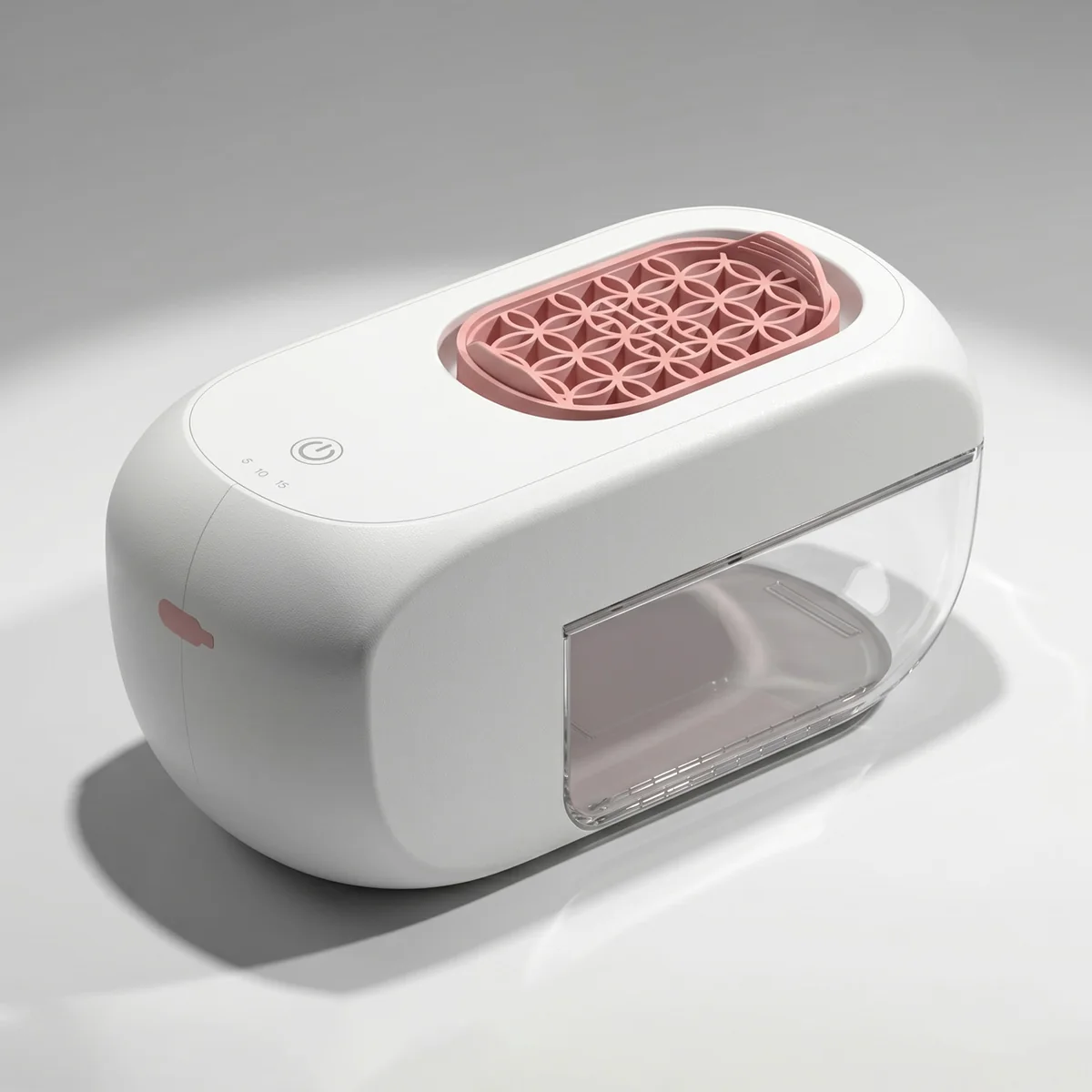
This is the honest part about tools. The brush cleaner we are developing at LARKBIRD mechanizes the washing half: percussive high-frequency impact drives cleaning force into the bristle root instead of spinning water around the surface, and the auto-stop means you drop the brush in, press start, and walk away. It removes the scrubbing labor entirely.
It does not change the drying half. Bristles wet from any wash — machine or hand — still need air, position, and hours. Water out of the brush still has to evaporate into the room. No tool shortcuts evaporation; that is physics, and any product claiming otherwise is selling something else.
Which is exactly why the schedule matters more than the hardware. A machine makes the washing half cheap enough to actually happen on time. Position and planning make the drying half invisible. Both halves together are what turn "I should clean my brushes more often" into a routine that survives contact with a real week.
The bottom line
Thin brushes dry in 2–4 hours, powder brushes in 4–6, dense foundation brushes overnight. Squeeze out the water with a microfiber cloth, dry flat with the head hanging off a counter edge or bristles-down, keep heat away from the ferrule, and schedule washes for the evening so brushes are ready by morning. Do that, and the downtime excuse for skipping washes disappears.
If the scrubbing half of the chore is what you dread, see the LARKBIRD Brush Cleaner Pro — and more brush-care guides are collected here.
FAQ
How do I know a makeup brush is completely dry?
Squeeze the bristles in a paper towel and check for damp spots or a musty smell. Brushes often feel dry at the tips while still wet at the root — anything cool or clammy needs more time.
Can I dry makeup brushes with a hair dryer?
Only cool air, held at a distance. Hot air weakens the glue inside the ferrule and can damage natural-hair bristles, which is why brushes tend to shed after heat drying.
Why shouldn't brushes dry upright in a cup?
Water runs down into the ferrule — the metal collar holding the bristles — where it sits against the glue. That is what loosens bristles and causes shedding over time.
Can I use a brush that is still slightly damp?
Better not. A damp brush picks up powder unevenly and streaks liquid foundation, and a damp bristle root is exactly where buildup and odor come back fastest.