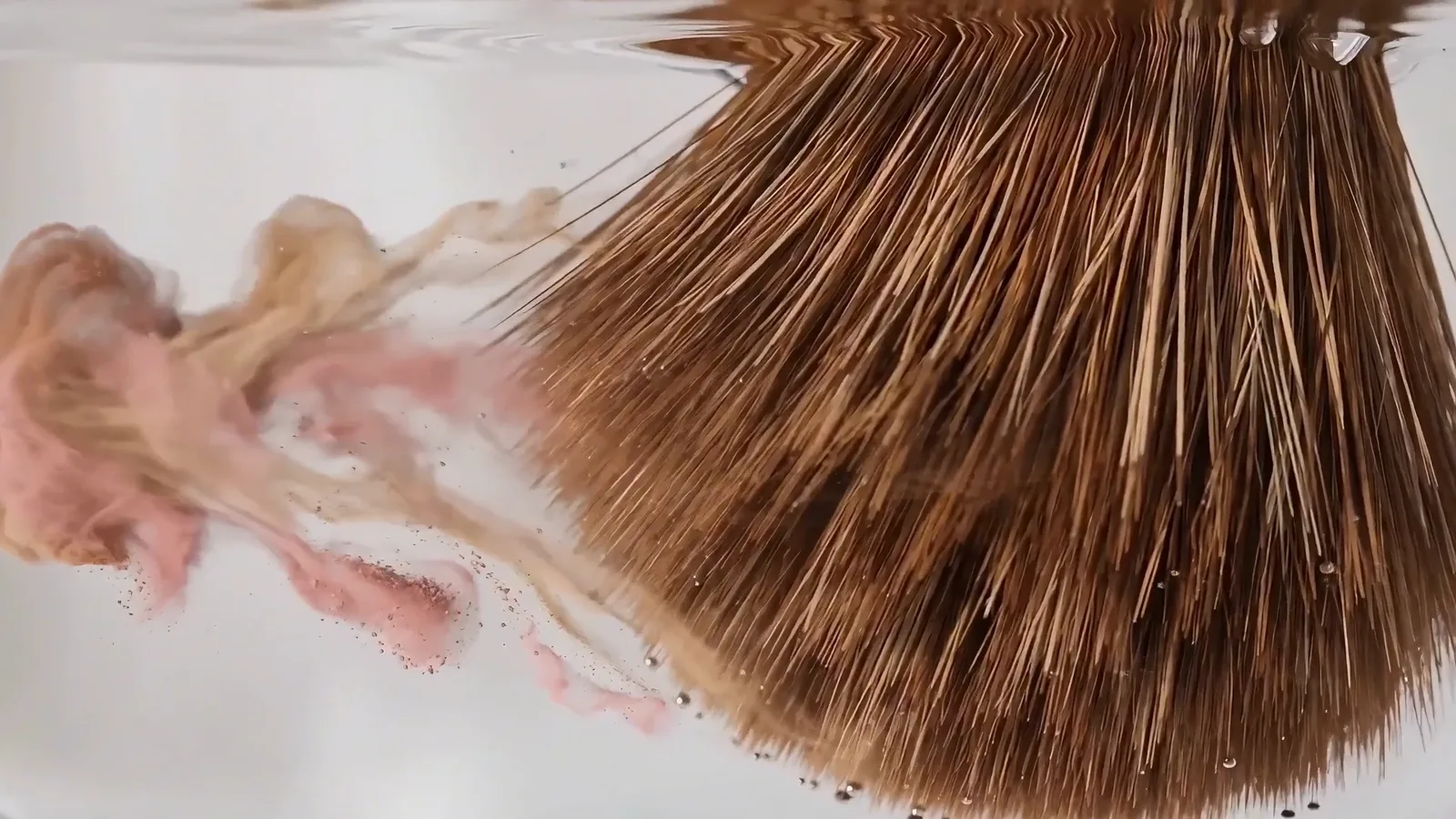
When foundation goes on patchy, the blame usually follows a fixed order: skin too dry, primer wrong, formula too heavy, technique sloppy. The brush gets checked last, if at all — and it is the one item on the list you can test in under a minute.
What "patchy" actually is
Patchiness is uneven deposit. Some areas of skin get more product than others, so the finish alternates between covered and sheer, and streaks appear where each brush pass laid down a partial line instead of a continuous film. Blending can only redistribute what the brush deposited — it cannot invent coverage where none was applied.
That is why patchiness is worth tracing back to the tool. Application quality is decided in the moment the bristles meet the skin, and whatever is on those bristles at that moment ends up on your face.
How residue changes how a brush applies
A brush used with foundation, concealer, or any cream product collects residue every day, and the collection concentrates where you cannot see it: at the bristle root, the dense base near the ferrule. Foundation and concealer harden there. As the layer builds, it stops behaving like clean bristles and starts behaving like a crust around them.
The visible symptoms map to the mechanism:
| What you see in the mirror | What is happening on the brush |
|---|---|
| Foundation skips in patches | Hardened root residue stiffens whole groups of bristles, so pressure transfers unevenly and some zones get no product |
| Streaks that will not blend out | Clumped bristle tips deposit lines of product instead of a smooth film |
| Color looks muddy or slightly off | Old pigment held in the bristles mixes into the fresh product you load |
| Powder sits on top instead of setting | Coated bristles pick up and release powder unevenly, leaving over-pressed spots |
| Application gets worse the longer you work | Each re-dip loads more product onto the clumps, so the deposit degrades mid-routine |
The muddiness symptom is the one people rarely connect to the brush. If the bristles still hold last week's pigment, that pigment releases into today's foundation and shifts the color slightly — which reads as "this formula is too orange for me" when the formula is fine.
The 60-second brush check
Two checks, both cheap:
1. The tissue test. Take a brush that looks clean and swipe it firmly across a white tissue or paper towel. If any pigment transfers, that is old product sitting in the bristles — the same pigment that will mix into your next application. 2. The pinch test. Grip the bristles near the base and squeeze. A clean brush root feels springy. A dirty one feels crusty, waxy, or greasy — that is the hardened layer at the root. This is the same check that makes the difference obvious after a proper clean: pinch the root before and after, and the contrast tells you instantly what the brush was carrying.
A brush that fails both tests has buildup beyond what the eye catches, and it is reasonable to suspect it before buying a new primer.
Why a quick rinse does not fix it
Here is the frustrating part: many patchy-brush sufferers do wash their brushes, and the patchiness survives. The reason is mechanical. A rinse under the tap, or a quick swirl on a palm, cleans the tips — the part that moves freely in the water. The root barely moves. Dense bristle packing blocks flow, cream products concentrate exactly there, and the hardened layer stays put.
So the brush returns to service looking clean and still applies like a dirty one, because the part that controls stiffness — the root — never got cleaned. Reaching it requires agitation delivered into the base of the bristles, not water moving around them. (How often that deep clean should happen is a schedule question — we covered the recommended intervals separately.)
Fixing the application, not the symptom
Once the buildup is removed, the brush recovers its original behavior: bristles flex evenly, pick up a full load, and release a smooth film. The patchiness caused by the tool disappears on the next application — no new foundation required.
Hand cleaning can get there, given patience and technique. What most people lack is the consistency, because scrubbing a foundation brush properly is fifteen minutes of tedious work — and when cleaning is tedious, the interval stretches and the residue returns. This is the problem our brush cleaner is built for: instead of spinning water around the brush, it delivers high-frequency impact — about 8,000 pulses per minute — directly into the bristle root, breaking up the hardened layer where it sits, with an auto-stop so you can drop the brush in and walk away. It is in development now; if the root-residue problem sounds familiar, you can reserve the LARKBIRD Brush Cleaner Pro.
One honest caveat: a clean brush will not fix every patchy face. Skin prep, formula, and technique each cause their own version of streaks. But the brush is the only cause on the list that you can test in sixty seconds at zero cost — so test it first, then decide whether the primer is really the culprit. And if drying time is what keeps you from washing brushes at all, the fix for that is scheduling, which we break down in the drying-time guide.
The bottom line
Patchy, streaky application often starts at the bristle root, where hardened residue stiffens the brush and dumps product unevenly. Swipe a "clean" brush on white tissue and pinch the root: pigment transfer or a crusty base means the tool is part of the problem. Clean at the root — not just the tips — and the same brush, same foundation, same skin will apply noticeably smoother. More brush-care guides live in the LARKBIRD brush cleaner hub.
FAQ
Why does my foundation look patchy even when my skin is well moisturized?
Moisture only fixes patchiness caused by dry skin. If the brush carries hardened residue at the root, the bristles flex unevenly and lay down product in streaks no matter how prepared the skin is.
How do I tell if my brush is the problem?
Two quick checks: swipe the clean-looking brush across a white tissue and watch for old pigment, then pinch the bristle root between your fingers — a crusty or greasy base means buildup the surface rinse never touched.
Does a dirty brush waste makeup?
Yes. Clumped bristles pick up less product evenly, so you re-dip and re-apply to cover the same area, and some of what the brush holds is old pigment you are paying to reapply.
How often should a foundation brush be cleaned to avoid patchiness?
Rinse after every two to three uses and do a deeper clean weekly — the same schedule dermatologists recommend, because the root buildup that causes patchiness forms within days of cream-product use.
Will cleaning the brush fix patchy makeup on its own?
Not always. Skin prep, formula, and technique all matter. But the brush is the one cause you can test in under a minute, and a clean-brush test tells you whether to keep troubleshooting elsewhere.