Almost everyone who starts pressing flowers starts the same way: the flower goes between two pages of the heaviest book in the house, and a stack of other books goes on top. It is the method your grandmother used, it costs nothing, and it genuinely works — up to a point. The question worth asking before you commit a wedding bouquet or a first-birthday rose to six weeks under an encyclopedia is what, exactly, a proper press does differently, and whether those differences matter for the flowers you have in mind.
The honest answer: a book is a press with the controls removed. Understanding which controls it lacks tells you when the book is enough and when it quietly ruins the batch.
What a book actually does
A book stack applies one force and only one force: the weight above the page, whatever that happens to be. There is no way to add pressure, no way to check that the pressure is even, and no way to release it without disturbing every flower in the book at once. The page-to-page pressure differs depending on how the pages bow and where the spines of neighboring books sit, so two flowers pressed side by side can come out noticeably different.
The second gap is moisture. A fresh flower is mostly water, and pressing flat does not dry anything by itself — water leaves only when something absorbs it or the air carries it off. Between book pages there is no absorbent layer doing that job; the paper in a book was never designed to wick water, so the flower dries on the book's timetable, slowly, while sitting in its own dampness. Slow drying is not just an inconvenience — it is the main reason pressed flowers turn brown before they ever reach a frame. If a batch has already come out blotchy, why pressed flowers turn brown walks through the five causes and how moisture starts four of them.
The third gap is the exit. Anyone who has pressed flowers in a book knows the ending: petals fused to the page, a thin paint of color left behind on the paper, and a flower that tears exactly where it stuck. The flower survived weeks of pressing only to be damaged on the way out.
What a press changes
A press does not replace the book's idea — weight, applied patiently — it adds the three things the book cannot do. Here is how the common setups compare on the things that decide whether a flower comes out usable:
| Bolt press | Book stack | Microwave kit | Ratchet press | |
|---|---|---|---|---|
| Tightening | Four nuts, one at a time | All the weight you own | Fast but harsh | A few pulls |
| Pressure | Uneven between bolts | Whatever gravity gives | Heats unevenly | Even across the whole board |
| Opening | Unscrew all four again | Dig it out | Watch it curl | One motion |
Three of those rows are worth pausing on.
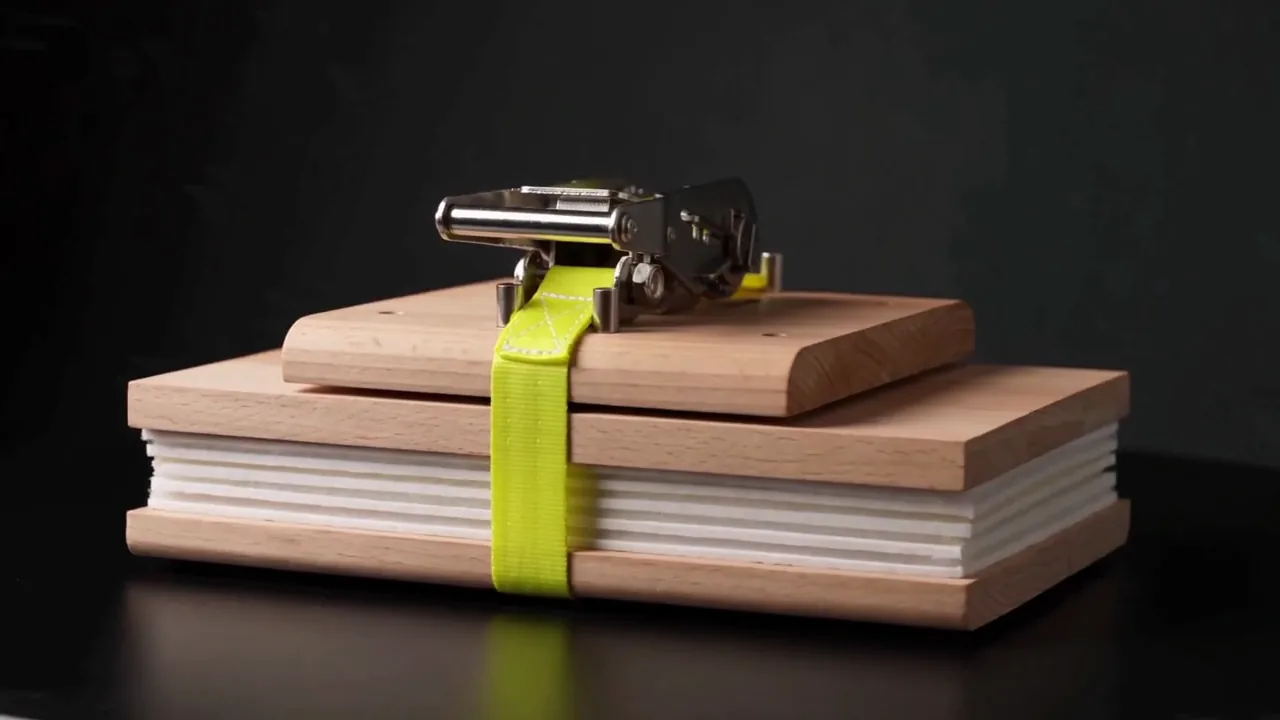
Tightening. A strap-and-ratchet press like the wisedry press takes a few light pulls to lock down — the ratchet only turns one way, so once it holds, it cannot creep loose. There is no equivalent of "adding another book" if the flowers turn out thicker than expected; the pressure is set in seconds and it stays set.
Pressure. The strap provides the pull, but a smaller plate under it spreads that pull across the whole board, so flowers at the corner press the same as flowers at the center. That is the difference between a batch where every petal dried flat and a batch where some petals dried and others stayed pliable — and pliable petals are the ones that brown and curl later.
Opening. This is the row people underrate until they have lost a flower to it. A ratchet press releases with one motion — lift the pin, press the release handle, and the strap goes slack. The flower lifts off the paper instead of being pried off a page. (Getting the paper layers right matters here too — which paper to use covers the two jobs the paper stack does and why parchment alone fails at one of them.)
When the book is genuinely fine
None of this makes the book useless. For casual flattening — a pansy from the garden going into a school notebook, leaves pressed for no particular purpose, a flower whose survival you will not mourn — the book is free and already in the room. Flat, single-layer flowers are the easy case for every method, and the flowers that press best are the same list either way: pansies, violas, daisies, cosmos, geraniums, most ferns.
The book stops being fine when the flower matters. Keepsake pressing — a bouquet from a wedding, a rose from a first anniversary, the first flower grown from your own seed — puts a premium on three things the book cannot promise: even pressure so every petal dries, managed moisture so color survives the wait, and a clean release at the end. Miss any one of those and the flower that came out of the book is not quite the flower that went in.
The difference in practice
Set both methods side by side on the same flat, single-layer batch. In the press, the stack — flowers between lining paper, foam and blotting boards inside a zip bag — goes into the boards, the strap pulls tight in a few draws, and the batch is drying in minutes. Flat flowers finish in 3–6 days, and the press opens in one motion when they do.
The book version of the same batch: flowers between pages, a stack of weights on top, and then the long part — weeks instead of days, with no way to peek without flattening everything around the flower, and no absorbent stack pulling water out while you wait. When the day finally comes, the petals that touched the driest pages lift clean and the petals that did not, do not.
That is the whole comparison in one sentence: the book presses flowers eventually; a press presses them evenly, dries them faster, and hands them back whole.
FAQ
Can you press flowers in a book?
Yes — thin, flat flowers between absorbent paper inside a heavy book have been the household method for generations. What you give up is control: the pages give whatever pressure gravity provides, the book itself soaks up moisture it was never meant to hold, and petals can stick or tear when you lift them out. For keepsakes you care about, a press with even, adjustable pressure is more forgiving.
Why do book-pressed flowers take longer to dry?
A book does not manage moisture — the flower just sits in its own dampness until the air in the pages slowly carries it away. A press stacks the flowers with lining paper, foam and blotting boards that actually pull water out, so flat single-layer flowers finish in 3–6 days and multi-layer flowers in 7–10. Slow drying is exactly how pressed flowers turn brown, so the method that dries faster also protects color.
What flowers work best in a book versus a press?
Both methods favor flat, single-layer blooms: pansies, violas, daisies, cosmos, geraniums and most ferns. Thick flowers like roses, lilies and orchids will not flatten under a book's uneven weight; in a press you trim the petals and arrange them flat on the boards. Either way, keep flowers of similar thickness in the same layer so they finish at the same time.
Do presses crush flowers that books would have pressed gently?
No — pressure is not the risk; uneven pressure is. A strap-tightened press spreads the same force across the whole board, so every petal is held flat, not squeezed at one point. A book stack presses hardest wherever the pages happen to bow, which is how flowers come out with one petal flat and another still curled.
How do I know when book-pressed flowers are done?
The same test as in a press: petals should feel papery and completely dry, with no coolness when you touch them. If a petal still feels cool or flexible, the moisture has not left yet — close the book or the press and give it more time before you lift the flower out.