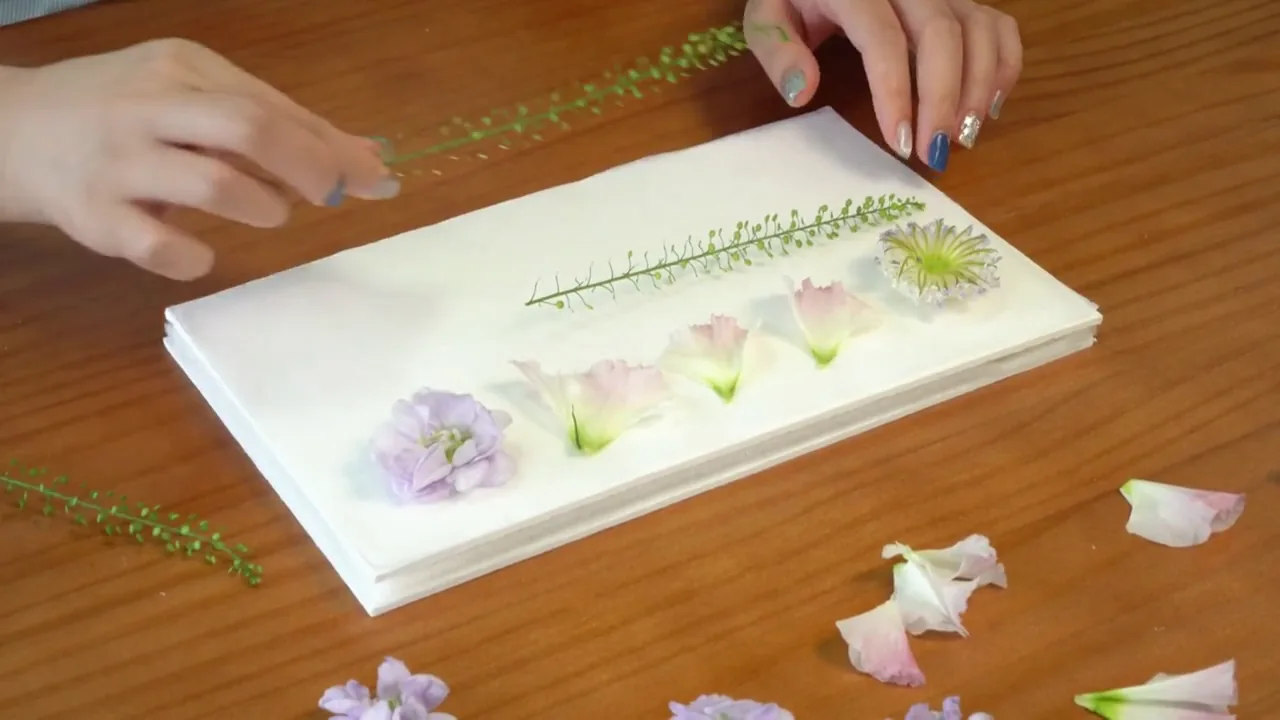
You have flowers picked, a press ready, and the internet has just told you four contradictory things about paper. Wax paper. Parchment. Newspaper. That roll of kitchen towel by the sink. Pick wrong and the batch pays for it: petals glued to the sheet, ink ghosts on a daisy, or a week later nothing has dried at all.
The good news is that paper is not one decision. It is two, and once you see the two jobs separately, every material falls into place.
Water has to go somewhere
A fresh flower is mostly water, and a press does not remove water — it only holds the flower flat while something else absorbs it. That something is the paper stack. Pressure spreads the petals out; the paper takes the water away. When people say their flowers "never dried" after two weeks in a press, the cause is almost never the press. It is that the layer touching the flower could not absorb anything, so the moisture had nowhere to go.
Where moisture lingers, trouble follows — slow drying is exactly how pressed flowers turn brown or grow mold. (If your batch has already come out blotchy, why pressed flowers turn brown walks through the five causes.)
The two jobs: a smooth face and a dry spine
Look at what the paper actually touches, and the jobs split cleanly:
- The smooth sheet against the flower. Petals are delicate and slightly tacky while wet. A smooth, non-fiber-shedding sheet gives them a clean surface to dry against, so they lift off intact when the press opens.
- The absorbent layer behind it. This is the workhorse. It needs to pull water out of the petal and hold it — for days, in a stack that may hold several layers of flowers at once.
One sheet cannot do both jobs. A material that is smooth usually is smooth because it is coated, and the coating that stops sticking also stops absorption. That single fact explains most pressing-paper failures.
The papers, compared
| Paper | Absorbs water? | Against the flower | Verdict |
|---|---|---|---|
| Parchment / wax paper | No — coated surface | Nothing sticks to it | Smooth sheet only, never the absorbent layer |
| Kitchen towel | Yes, quickly | Texture prints into soft petals | Emergency absorbent layer, not a first choice |
| Newspaper | Yes | Ink can transfer to petals | Skip it — you cannot control what bleeds |
| Watercolor or cartridge paper | Yes | Fibers can cling to thin petals | Usable absorbent layer, but thick for a stack |
| Cardboard-type blotting boards | Yes, and lots of it | Sits behind the layers | The real drying engine |
| Smooth lining paper | Lightly | Petals lift off clean | The face sheet against flowers |
Two rows matter most. Parchment paper is the most common mistake: it behaves like the smooth sheet it is, so people lay flowers between two sheets of it and the flower sits in a sealed pocket of its own moisture. Kitchen towel absorbs well, which tempts people to use it alone — and the embossed pattern presses straight into a soft petal, where no amount of later flattening removes it.
How the layers work in the press
A press stack divides the two jobs across layers. In the Wisedry ratchet press, the intended stack runs: flowers laid flat between lining paper, foam sheets outside the paper, and blotting boards as the absorbent spine — then the whole stack slides into a zip bag and the strap pulls it tight. The kit ships with six foam sheets, eighteen lining-paper sheets and six blotting boards, sized for the 27.5 × 17.5 cm boards, so a whole batch goes in and comes out as one unit.
The division of labor is worth spelling out, because it is why substitution fails so reliably:
1. Lining paper — the face. Petals dry against it and release cleanly. 2. Foam — the cushion that evens out thickness differences across the board. 3. Blotting boards — the spine. They hold the water the flower gives up, which is why they can be recharged between batches (on their own, in a microwave or oven, per the user guide — never unattended, and never the press itself, which has metal parts).
Swap any layer for a random household sheet and one of the three jobs goes undone. Printer paper is the classic example: it looks like paper, sits where paper sits, and traps moisture against the flower instead of pulling it out.
What the right paper changes about timing
Paper choice sets your timeline, not just your finish quality. With an absorbent layer that is actually working, leaves press in 1–3 days, flat single-layer flowers in 3–6, and multi-layer flowers in 7–10. A batch pressed between two coated sheets can sit twice that long and still come out damp — the clock never started.
Open a batch to check rather than trusting the calendar: petals should feel papery and completely dry. And keep flowers of similar thickness on the same layer — a flat viola and a fleshy geranium dry at very different speeds, so mixing them means one layer's schedule for every flower in it. The full pressing timeline breaks down what to expect by flower type.
The bottom line
Use two papers, not one. A smooth lining sheet against the petals so they lift off clean, and a real absorbent layer — blotting boards are what a press kit ships with — behind them to pull the water out. Parchment and wax paper are smooth sheets pretending to do the absorbent job; kitchen towel works in a pinch but stamps its texture into soft petals; newspaper gambles your batch on its ink. Get the two jobs separated and the rest of pressing is just waiting.
See the Wisedry Ratchet Flower Press.
FAQ
Can I use parchment paper to press flowers?
Only as the smooth sheet touching the flower, never as the only paper. Parchment is coated, so it does not absorb water — petals laid between two parchment sheets sit in their own moisture and take far longer to dry, which is how browning and mold start. Put an absorbent layer behind it.
How many sheets of paper do I need per layer?
One smooth sheet under the flowers and one on top, with the flowers arranged flat in a single layer. Outside the paper goes foam, then blotting boards. Keep flowers of similar thickness on the same layer so they finish at the same time.
Do I need to change the paper during pressing?
Not mid-batch. The blotting boards do the drying for the whole run — flat, single-layer flowers finish in 3–6 days, multi-layer flowers in 7–10. Between batches, let the boards dry out or recharge them following the user guide, because saturated boards stop pulling water.
How do I know when flowers are dry enough to come off the paper?
Petals feel papery and completely dry — no coolness when you touch them. If petals still feel cool or flexible, close the press and give them more time; pulling a damp flower off the paper is how petals tear.