Where the fear actually comes from
Every keeper who hears a story about a hen caught by a closing door asks the same question before buying. The honest starting point: a pop door driven by a motor *can* hurt a bird — any brand, any budget. The flap is a rigid panel and a bird in the wrong place at the wrong second is in trouble. Pretending the risk does not exist is how brands end up with a support inbox full of it.
But look at the stories closely and a pattern emerges. The door that hurt the bird almost never did it with brute force. It did it with *silence* — a motor that kept pushing against something soft because nothing told it to stop, or a door that gave up in the wrong position and nobody knew until the light came up. The failure mode is the danger, not the horsepower.
So the useful question is not "is the door strong" but "what does the door do when something is in the way." That is a spec you can read before you buy.
What makes a closing door dangerous
Lifting a pop-door flap takes very little force, and every manufacturer knows it. The variable that separates a safe door from a lawsuit of a door is the blocked-door routine:
| Door behavior when blocked | What actually happens | Risk to the flock |
|---|---|---|
| No stall detection — the schedule closes the door, the motor pushes | The door grinds or hums against whatever is in the way | Highest: endless pushing in silence |
| Stall detection, but retries quietly | The door stops or backs off, then tries again and again | The door gives up, the coop stands open, and nobody knows |
| Staged retries, then a hard stop and an alert | The door backs off, retries a couple of times, then stops for good and phones you | Lowest: no grinding, no silent failure |
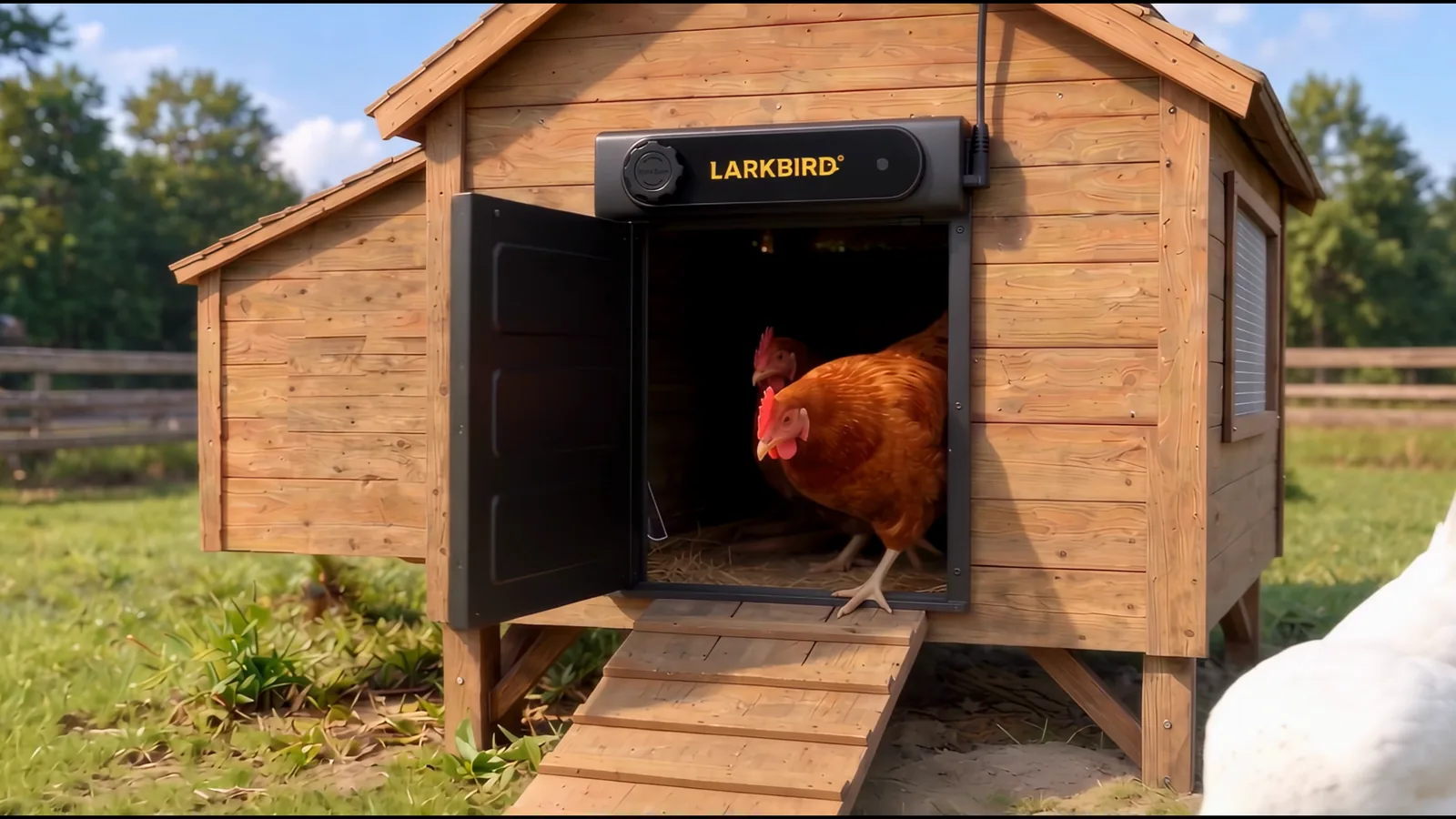
The last row is the standard worth shopping for, and it is the standard the LARKBIRD Smart Coop Door is built around. A door you can trust is a door that reports — every state change you care about arrives on your phone instead of being discovered at sunrise.
How the LARKBIRD door handles a blockage
Here is the actual routine, from the spec sheet rather than marketing gloss. If the door meets resistance, it backs off and retries twice. The third attempt pushes full power for five seconds. If it is still stuck, it stops for good and the alert lands on your phone. There is no fourth attempt, no all-night grind: the door does everything reasonable to complete its move, then refuses to keep fighting whatever it cannot move.
The reporting does not stop at the closing. If something pulls the door open from outside during the night — the raccoon scenario — you hear about it. Every two hours the door verifies its own motor and its radio link and reports drift, so a weakening motor shows up in the log long before it becomes a failure. And the last 50 door events stay stored on the unit, each marked done or failed, ready in the app: when something went wrong at 2 a.m., you can replay the night instead of guessing at it.
Speed matters too, gently. In one continuous endurance run the door completed 204 cycles — 102 opens, 102 closes — with zero failures, and the average move took 0.25 seconds, the slowest single move 5.5 seconds. A flap that crosses its track in a fraction of a second rarely shares that second with a bird; when a move does run long, that is precisely the kind of event the alerts exist to flag.
Cold, ice, and the honest limits
Winter mornings are the other moment people picture. Before opening in freezing weather, the door checks its own position and retries with extra force to break light ice, writing every ice-break to the log. Severe icing can still stop the door — and when it does, you get the alert, not a silent failure. That last sentence is the whole philosophy in miniature: the door does not pretend it can beat anything. It promises that you will know.
The habits that matter more than the motor
Hardware handles the freak event; routine prevents the common one. Three habits cover almost every scenario where a closing door and a chicken occupy the same second:
Close the door after the flock is in, not before dark falls on them. Chickens head to the roost as the light fades, usually finishing well before full dark. The LARKBIRD door closes a set number of minutes before your location's actual sunset — calculated from real sun times, adjustable up to 60 minutes either way — so set the offset so the door moves *after* your flock's bedtime, not during it. If some of your hens are chronic stragglers, deal with the cause: bullies, mites, and dark doorways explain most of them.
Make the dusk headcount a glance, not a chore. The app shows the door's state and recent moves; if a hen is still pacing the run at closing, you tap to reopen, let her in, and lock up again from the same screen. Ten seconds, from anywhere.
Do not hand the controls to the night. A smart door with an exposed button is a raccoon toy. There is nothing to press on the outside of the LARKBIRD unit — and a pull-open at night triggers an alert anyway. The door is one layer of the defense; a full raccoon checklist covers the rest.
| Scenario | What the door does | Your move |
|---|---|---|
| A hen lingers in the run at closing time | The door closes on its sun-timed schedule; nothing dramatic happens | Reopen from the app, let her in, lock up — then fix the straggler cause |
| A bird darts through at the last second | A normal cycle crosses the doorway in about a quarter second; contact makes the door back off and retry, not grind | Watch one dusk; move the close offset earlier if your flock runs late |
| Something jams the track overnight | Backs off, retries twice, stops for good, alerts; the event sits in the log marked failed | Clear the jam, run one full cycle, confirm it reports done |
| Ice locks the flap before dawn | Position check first, extra force for light ice, every ice-break logged | Severe icing stops the door with an alert — clear it by hand and reopen |
| You are away for the weekend | Battery warns at 30% with days of runtime left; self-checks every two hours; pull-open alerts at night | Keep notifications on — a neighbor only needs the ladder if the app says so |
An automatic door earns trust the same way a good farmhand does: not by never making a mistake, but by saying so immediately when something is wrong. Buy the door that reports, set it to close after the roost bar fills up, and the question in the title stays a question forever.
Read next
- Why won't my chickens go in at night? — the straggler causes and the fixes
- Raccoon-proofing your coop: the checklist — where the door fits into night security
- Timer vs. light sensor vs. sun times — how the door picks its minute
FAQ
Are automatic chicken coop doors safe for chickens?
A well-designed one, yes — safe in the way that matters: if something is in the way, it stops pushing and tells you instead of grinding in silence. The injuries you hear about come from doors with no stall behavior at all, or from failures nobody discovered until morning. Hardware aside, the biggest safety margin is timing: set the door to close while the flock is already roosting.
Do automatic coop doors have sensors that detect a chicken?
Almost never a camera or a light beam at this size. Doors sense a blockage through the motor itself — the motor stalls or draws differently when the flap cannot move. That is why the stall routine is the spec to read: does it back off, does it retry, does it stop for good, and does your phone find out.
What happens if a hen is still outside when the door closes?
With the LARKBIRD door you reopen it from the app wherever you are, let her in, and lock up again from the same screen — every action comes back confirmed and lands in the log. Then fix the reason she lingered: bullies, mites, or a dark doorway are the usual suspects.
Can a raccoon open or jam an automatic coop door?
Raccoons work latches and press switches, so the LARKBIRD door has nothing exposed on the outside to press — and if something pulls the door open from outside, the alert reaches your phone. That said, a door is one layer of night security, not the whole defense; run a full raccoon checklist too.
Is it safe to run the door while I am away for a few days?
That is exactly what the reporting is for. Stalled moves alert in stages, the door self-checks its motor and link every two hours, the last 50 events stay on the unit marked done or failed, and the battery warns at 30% while days of runtime remain. A failure becomes a notification instead of a discovery.