The short answer
A heated glove is a small electrical system wearing a glove's costume. A rechargeable battery sends low-voltage current through thin heating elements that are sewn into the fabric. The elements warm up — quickly, in a good pair — and the fabric carries that heat to the back of your hand and your fingers. You control it with one button: on, level, off. That's the whole machine. Everything else in this article is about the details that decide whether the machine actually works for you, because "heated glove" describes a category with enormous internal differences.
The three questions that matter: where does the heat land, how do you control it, and what happens when the battery runs flat? Get those right and the glove disappears into your day. Get them wrong and you own a bulky glove that warms the wrong spots and dies at noon.
The parts, piece by piece
Every rechargeable heated glove on the market is built from the same five components. The differences between a good pair and a disappointing one live in how each part is chosen.
| Part | What it does | Where designs differ |
|---|---|---|
| Battery | Powers the elements; the only consumable | Capacity, voltage, how many ship in the box, where it sits on the glove |
| Heating elements | Thin wires in the fabric that turn current into heat | How far they reach — back of hand only, or both sides of every finger |
| Controls | Button to switch on and pick a level | One button vs fiddly cycles; whether indicator lights fade or blink all day |
| Liner | The fabric that holds elements and touches your skin | Thickness — thin knit keeps fingers working; bulk buys warmth at the cost of dexterity |
| Charger | Refills the batteries | Single vs dual-head; whether a charge indicator tells you when the spare set is ready |
Notice what is *not* on the list: insulation. Insulation is what makes ordinary gloves work — it slows down heat escaping. In a heated glove, insulation is secondary; the glove *makes* heat, so the fabric's real job is distributing it evenly and staying thin enough that your hands remain usable. That is why heated gloves are a different machine from pocket warmers, and why the liner's thickness turns out to matter more than most buyers expect.
Where the heat lands — the part most specs hide
Here is the detail that separates thoughtful designs from lazy ones, and it is almost never visible in a product photo: the routing of the heating elements.
The common approach runs elements across the back of the fingers and stops there. It's cheaper and simpler, and it photographs fine. But look at where cold hands actually suffer: the fingertips — the parts holding a pen, tapping at a keyboard, gripping a steering wheel. Heat that stops at the knuckles leaves the working ends of your fingers out in the cold, which is the same placement failure that makes ordinary gloves leave fingers cold.
Our liner takes a different route deliberately: elements across the back of the hand and up both sides of all five fingers. The both-sides choice is not cosmetic — heat arriving from both sides of a fingertip is what makes the fingertip feel warm, the way holding a mug with your whole hand beats pinching it with two fingers. When you compare gloves, this is the spec to hunt for, because it predicts your actual experience better than any temperature number.
How the controls and levels work
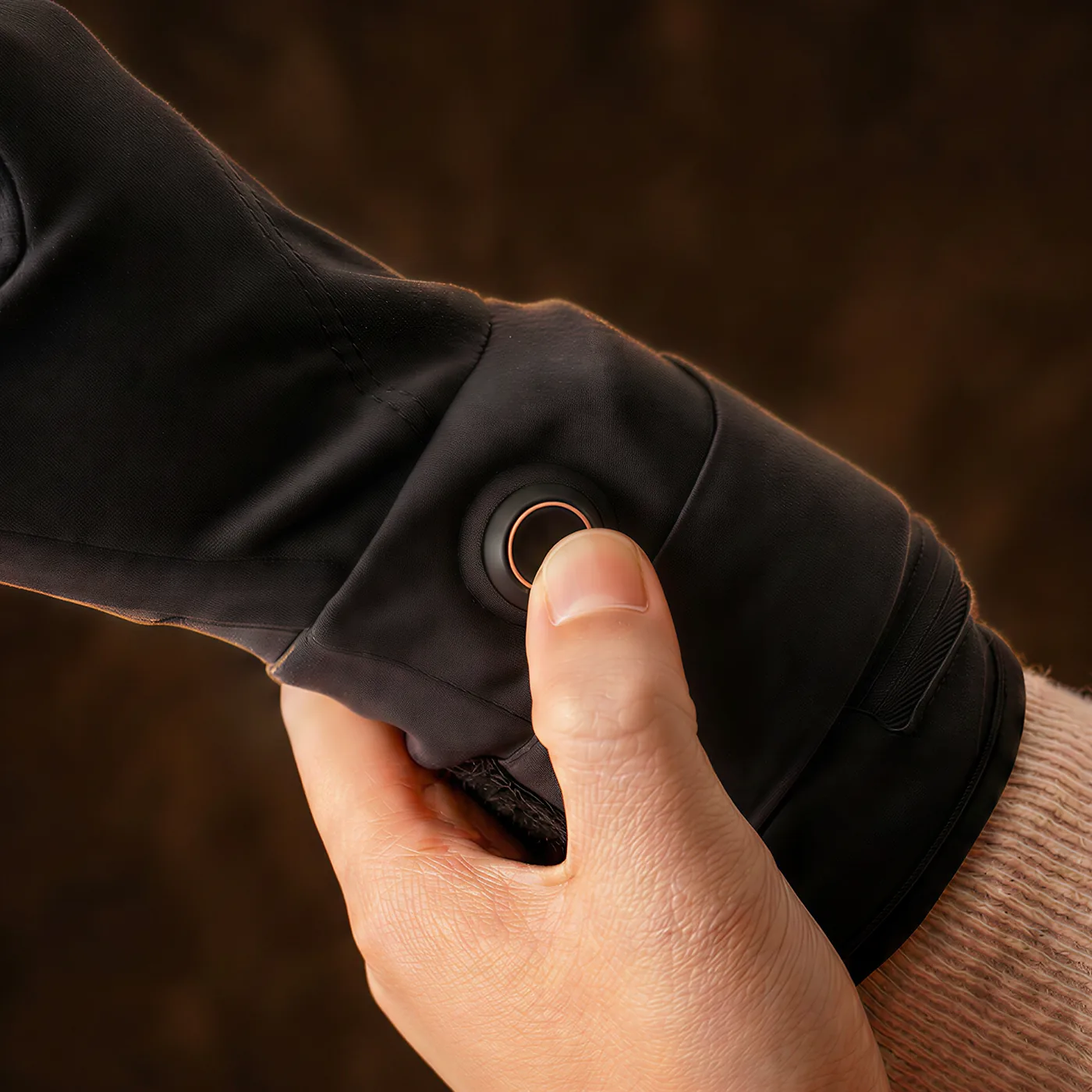
A good heated glove keeps control boring. Ours is one button on the battery pod: press it, warmth is perceptible within about ten seconds, and you cycle through three levels — 104°F, 122°F, 140°F. A small indicator confirms the level, then fades after three seconds so nothing keeps blinking at you in a meeting.
Why fixed levels instead of a dial? Because a dial invites guessing, and guessing leads to either sweating or checking. Three distinct levels cover the real-world range — mild indoor chill, a cold commute, outdoors under a shell — and each is set once, then forgotten. The low-tech routine is the feature: on in the morning, level to taste, off when you're back in a warm room, exactly the simple daily rhythm that makes all-day wear practical.
The power system — batteries, charging, and the honest runtime question
The battery is where heated gloves live or die, in two separate ways.
First, the math of a day. Most heated gloves ship two batteries — one per glove — and when both run flat, you are chained to a wall outlet while they charge. Ours ship four: two full pairs. When the set on your hands runs flat, you click in the charged spare and keep moving, and the dual-head charger refills the empty pair in the background. The battery stops being a countdown and becomes a rotation. That structural difference is exactly why heated gloves shut down mid-day on two-battery designs.
Second, the honest number. Runtime per charge depends on the level you run — higher settings spend the battery faster — and it varies with conditions, so any brochure figure deserves suspicion. We measured heat-up, levels, and charging on pre-production samples; production-unit runtime is being re-confirmed now, and we'll publish measured numbers when they're confirmed, not before. What we can state plainly: each battery is a 7.4V, 2200mAh pack, the pod sits on the back of your hand where it stays clear of your wrist while you type, and swapping a set takes seconds.
Why liner thickness matters more than you'd think
The last part is the one that decides whether you actually keep wearing them indoors. Heat you can't work through is heat you'll take off — and the moment the gloves come off, the cold comes back. That's why our build is an ultra-thin liner in a soft, double-brushed knit rather than a padded ski-style glove: the elements add the warmth, so the fabric doesn't have to be thick to keep your fingers usable for typing, texting, and small tasks. The touchscreen threading in the thumb and index fingertips is the same philosophy — the gloves never have to come off for a text. If you're weighing a thick outdoor model against a thin liner for everyday wear, what you can actually do while wearing them is the test that settles it.
What to check before you buy any pair
Reduce any heated glove to its five parts and the shopping decision gets simple:
- Element reach — back-of-hand only, or both sides of all five fingers? This decides whether fingertips actually warm up.
- Batteries in the box — one pair or two? Two pairs means a flat set is a swap, not a shutdown.
- Levels and controls — distinct, settable levels with a quiet indicator, or a blinking light you can't turn off?
- Liner thickness — thin enough that your fingers still do their job?
- Silhouette — does it read as an ordinary glove, or as ski equipment you'll have to explain indoors?
Ours were designed around those five answers: heat across the back of the hand and both sides of all five fingers, three levels from 104°F to 140°F, warmth within about ten seconds, four batteries with a dual-head charger, a double-brushed knit thin enough to keep typing in, and a look that stays an ordinary glove. The full specifications — and an honest account of what's confirmed versus still being verified on the first production run — are on the Heated Liner Gloves page.
FAQ
Do heated gloves make heat without a battery?
No. Regular gloves only hold heat your hands already produce — insulation slows heat escaping, it doesn't add any. A heated glove adds an actual heat source: battery-powered elements inside the fabric. Without a charged battery connected, the elements stay cold and the glove behaves like an ordinary thin liner.
Are heated gloves safe to wear all day?
Reputable pairs run on low-voltage DC power with the temperature capped by fixed levels — ours top out at 140°F, roughly the range of a very warm bath, far below anything that harms skin. The honest framing is the one our own page uses: these are comfort products, not medical devices. What matters for all-day wear is less heat and more fit and bulk — see [wearing heated gloves all day](../heated-gloves-can-you-wear-heated-gloves-all-day/).
Why don't heated gloves get as hot as a hand warmer?
By design. A pocket hand warmer sits outside your skin and can run very hot; a heated glove puts elements against the back of your hand, so the temperature has to stay in the comfortable range — that's why the levels on ours stop at 140°F. Staying comfortable for hours beats a scorching peak you have to pull off.
How long do heated glove batteries last?
Runtime depends on the heat level you run, and any honest number comes from measured tests. We measured heat-up, levels, and charging on pre-production samples and are re-confirming runtime on production units before publishing figures. The structural answer matters more day to day: four batteries in the box means a flat pair swaps out in seconds instead of ending your day.
What's the difference between cheap and good heated gloves?
Four things, all visible on the spec sheet. Where the elements reach — back of hand only, or both sides of every finger. How many batteries ship in the box — one pair means planning your day around a charger. How thick the liner is — bulk decides whether your fingers still work. And what it looks like — ski styling reads loud in an office. Details in [our comparison with disposable warmers](../heated-gloves-vs-disposable-hand-warmers/).