The smell you notice before you see anything
You lean in to smell a dried rose — expecting the ghost of the bouquet, and getting a basement instead. Nothing looks wrong: the petals hold their shape, the color is still there, maybe a bit duller than the day you hung them. But the flowers smell musty. And musty is not a neutral fact about a dried flower. It is the smell of moisture that has come back, and it usually arrives before anything you can see does — mold shows up on dried flowers weeks after the air around them turned damp, and the nose finds it first.
This is the fourth way a dried arrangement fails — brittleness means too dry, fading means too much light, mold means visible trouble, and musty means moisture is back before anything shows. Of the four, musty is the most worth acting on: act in the first days and the flowers can usually be saved, wait and they are gone.
Where the smell actually comes from
A properly dried flower has almost no smell at all. The volatile compounds that made the fresh rose smell like a rose are mostly gone with the water; what is left is a paper-dry skeleton that gives off very little. A healthy dried arrangement smells like *nothing* — so any smell at all is information.
Musty smell comes from two very different sources, and the fix depends on which one you have.
Source 1: the bouquet was never fully dry. This is the most common cause, and the cruel one, because the smell appears weeks after you did the drying. Home drying leaves moisture pockets inside thick blooms — a rose head is dense enough that its center still holds water while the outside passes the squeeze test. Weeks later that hidden moisture either slowly evaporates into the room (taking weeks, smelling the whole time) or starts the mold clock inside a flower that looks fine from the wall. If yours smelled fine for a day or two after drying and then went musty, this is almost certainly what happened.
Source 2: moisture has come back. Petals are hygroscopic — they reabsorb water from the air around them faster than they release it. A bathroom arrangement, a display hung on an exterior wall in a wet winter, a bouquet stored in a basement or attic, flowers kept near a kettle or in the steam zone of a kitchen: all of them are slowly re-wetting a skeleton that was supposed to stay dry. The musty smell is the skeleton telling you it is damp. This is the same door that leads to brittleness on the dry side and mold on the wet side.
The three places smell fails a dried bouquet
A rushed drying job. Bouquets hung in a bunch in a humid summer room, pulled down when they *felt* dry: outer petals pass the squeeze test while the centers of thick blooms still hold water. Two or three weeks later the musty smell arrives, and by then the centers may already be speckled with the start of mold. Thick flowers (roses, peonies, hydrangeas) are the usual victims — they feel done long before they are done.
The wrong room. A steamy bathroom or above a kettle is the fastest route back to damp petals. But the quieter failure is an exterior wall in a wet climate: the wall itself runs cool, and a shadow box hung flat against it sits in a layer of cool, slowly humid air. The arrangement is doing nothing wrong; the location is feeding it moisture every day. Same for a basement or an unheated attic — the air in those spaces is exactly the air the smell is named after.
A sealed container without moisture control. This is the trap that catches people who did everything else right. Somebody tells you "seal them in a box and they'll be safe" — and it works, until it doesn't. A sealed display holds the air it was closed with: dry air stays dry, damp air gets preserved as damp. Worse, if the bouquet went in slightly damp, the sealed box holds that moisture against the petals with nowhere to go — the box that was supposed to protect the flowers becomes the moisture that finishes them. Sealing is not protection by itself; sealing plus something that manages the moisture you sealed in is.
The fixes that don't fix
Baking soda. The classic internet remedy, and it works — for a specific case. Baking soda absorbs odor molecules from the *air*, so it helps when the smell has a source outside the flowers: a smoky room, the storage box they shipped in, a whiff of paint. Nestle the arrangement in a container with baking soda, close it, give it a night or two. What baking soda cannot do is pull moisture back out of petals — a truly damp bouquet comes out smelling musty again within days.
Perfume or essential oils. The worst of the options. Perfume, oils and linen sprays sit on the petal surface and leave residues, can spot the color and dull the surface — and, the real problem, they mask the signal. Musty is the earliest warning of mold; spraying perfume over it hides the one clue you had while the mold clock keeps running. If a dried arrangement smells musty, that is the voice of the flower telling you something. Don't shout over it.
Just sealing them up. "Put them in a shadow box and the smell stops" is backwards. Sealing preserves the state of the flowers *as sealed* — damp goes in, damp stays in, and the smell comes back worse because now the moisture is trapped an inch from the glass. This is the one fix that actively makes things worse when applied to a bouquet that is already musty. Seal dry flowers in a managed enclosure; do not seal a problem into one.
The fix that works: dry them out, then keep them dry
Musty = moisture back in the petals = the fix is to take moisture out of the petals. That is the whole of it, and it splits into a rescue and a prevention.
The rescue, for faint recent musty smells. Move the arrangement to the driest, most stable room you have, hang it out of direct sun, and let dry air work — days, not hours. If the musty was recent and faint, the small amount of moisture in the petals can evaporate back out, and the smell fades with it. Add a bowl of silica gel beside the arrangement (not touching the flowers — bare gel desiccates what it touches and can over-dry petals brittle-fast), a small fan on low across the room's air — not aimed at the loose petals — and two to three days later reassess. If the smell is strong, or anything speckled shows up, stop the rescue and accept the loss — that arrangement is past saving, and the whole room's air can't pull back a colonized petal.
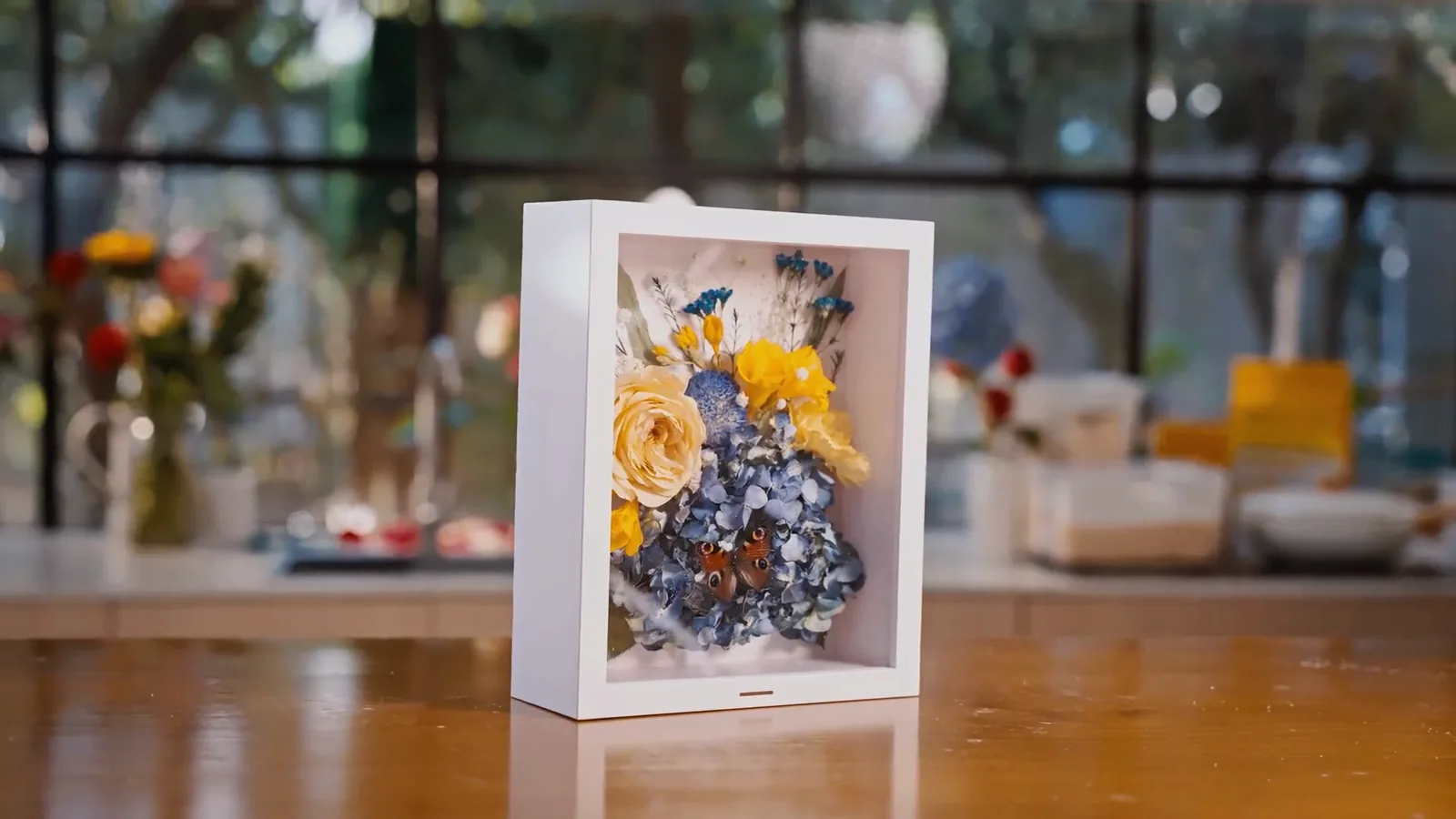
The prevention, which is where a shadow box earns its keep. Once flowers are fully dry, the job changes from removing moisture to keeping it out — a keeping-out job that needs two things: a physical barrier and a moisture manager. The barrier keeps the room's weather off the petals; the manager handles the air sealed inside. This is the exact pair the Wisedry shadow box pairs: a one-piece ABS body with no joints for moisture to pass through, a full-perimeter sealing strip behind the backing that closes the rim, and 100g of indicating silica gel in hidden compartments that manages the air sealed inside — with the front window showing orange-to-green so you know the silica still has capacity left. Sealed box, managed air — the enclosure that holds the flowers in the state you closed them in.
The table version:
| Approach | What it does | Verdict |
|---|---|---|
| Move to dry room + wait | Evaporates the small moisture that came back recently | Works if the smell is faint and recent |
| Baking soda bath | Absorbs odor molecules from the air around the flowers | Helps with non-moisture odors only |
| Perfume / essential oils | Covers the smell with a stronger one | Never — hides the early-warning signal, spots petals |
| Seal into a plain box | Traps the current air with the flowers | Backwards — traps damp in, smell returns worse |
| Sealed display + silica gel | Keeps room moisture out and manages the air inside | The only fix that lasts beyond a week |
If yours smell musty right now
Three steps, in order. First, sniff-test each bloom individually — if one flower is the source and the rest smell of nothing, remove and discard that bloom before the moisture spreads its clock to its neighbors. Second, move the survivors to the driest stable room you have and give them days, not hours — dry air is the only thing that pulls moisture back out. Third, once they pass the sniff test, give them a home where the room's weather cannot reach them — a sealed, silica-managed display that keeps the dry state you just restored.
Keep the smell out for good. The Wisedry dried-flower shadow box is the enclosure built for the job — sealed, silica-managed, with an orange-to-green window that shows the moisture being managed — on an interior wall near you.
FAQ
Can you fix flowers that already smell musty?
Sometimes. If the smell is faint and recent, moving the arrangement to dry, stable air and letting it sit can pull the small amount of moisture back out — the earlier you catch it, the better the odds. If the smell is strong or the flowers show [visible mold](../dried-flower-shadow-box-why-did-my-dried-flowers-go-moldy/), no fix is safe: the structure of the petals is already colonized and the arrangement is past saving.
Do shadow boxes make flowers smell worse?
Not if the flowers go in dry. A sealed display holds the air it was closed with — dry air stays dry, damp air gets preserved as damp. The frame is not a drying system: that is why [flowers must be fully dried first](../four-ways-to-dry-flowers-compared/), and why the box pairs the seal with silica gel that manages whatever moisture is sealed inside.
Is baking soda a good fix for musty dried flowers?
It can help with an odor that has a source outside the flowers — a smoky room, a storage smell from the box they shipped in. Nestle the arrangement in a container of baking soda overnight. What it cannot do is pull moisture back out of petals, so a truly damp, musty bouquet will smell musty again within days.
Should I spray perfume on dried flowers to cover the smell?
No. Perfume, essential oils and linen sprays sit on the petal surface, leave residues, can spot the color, and — the real problem — they mask the signal. Musty smell is the earliest warning that [mold is starting](../dried-flower-shadow-box-why-did-my-dried-flowers-go-moldy/), and covering it hides the one clue you had.
How do I stop dried flowers smelling musty in the first place?
Three rules: dry the flowers completely before anything else, hang or store them in stable moderate room air — not a bathroom, not against an exterior wall, not above a heat source — and keep handling and humidity away from the petals. A sealed display with indicating silica takes over all three jobs after the first.