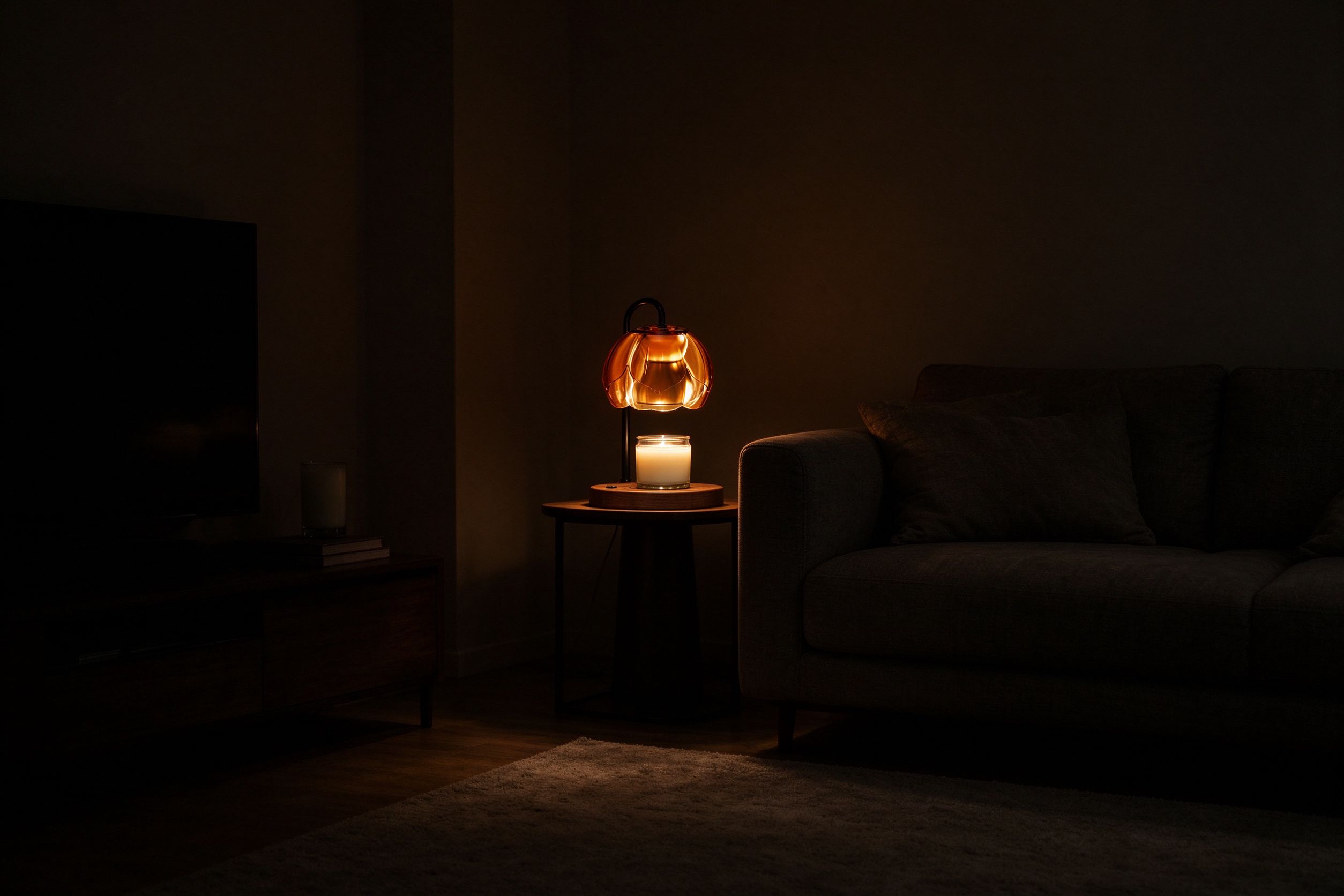
How scent actually leaves the wax
Fragrance never comes from the wick. In a burning candle, the flame melts a ring of wax around itself, and that liquid pool is where fragrance evaporates from — the flame's real job is to keep the pool wide and hot. In a candle warmer, the flame is simply gone and a heating element does the melting instead, which is why the wick never lights and the air stays clear of soot.
That one change explains most "why can't I smell it" reports. A warmer heats the candle from the top down, so the melt pool starts narrow and grows over the course of a session. A narrow pool releases less scent per minute than a wide one. Nothing is wrong with the candle and nothing is wrong with the warmer — the melt is just smaller, and smaller is slower.
This is also the trade you accepted, whether you knew it or not. Gentler release is the flip side of a candle that lasts longer: with only the top layer ever melting, no wax is wasted down the jar walls. We looked at the same physics from the other side in how long a candle warmer's scent actually lasts — the slower release is exactly why a warmed candle stretches so much further than a burned one.
The five causes, and what each fix looks like
Weak throw is almost always one of these five. Match what you are seeing to the middle column before changing anything else.
| What you notice | The likely cause | The fix |
|---|---|---|
| No scent in the first several minutes | The melt pool is still narrow — top-down melting starts small | Give it time; run a higher heat setting while the pool widens |
| Scent arrives, then fades | The pool stopped growing, or the top layer of wax is spent | Step the heat up; check whether the wax below still smells fragrant |
| A brand-new candle barely smells | Some candles are lightly scented, and warming is honest about it | Cold-sniff the jar before warming; if it is faint cold, it will be faint warm |
| Strong up close, nothing across the room | The room is large, or windows and fans are carrying air out | Use it in a smaller or closed room; move the warmer nearer where you sit |
| Every candle smells weak, not just one | The heat is sitting on a low setting | Raise the heat level a step and re-test with the same candle |
Two rows deserve a little more honesty. The third one is not a malfunction — a warmer simply reports what is in the wax, and a candle that smelled mild on the shelf will smell mild warmed. And the last one is easy to misdiagnose: people blame the candle, then blame the warmer, when the heat setting has quietly been on the gentlest level since the day they bought it.
Give the pool time to grow
The most common mistake is judging a warmer on a flame's timeline. A lit wick throws scent within minutes because it burns a pool wide immediately. A warmer spends its first stretch of a session getting there instead — the wax softens, the pool widens ring by ring, and the scent follows the pool.
Heat level is the lever that controls how fast that happens. On our own warmer, the ceramic element runs at 60%, 80%, or 100%, plus an Auto program that holds 100% for the first 5 minutes to establish the fragrance and then settles at 80% for the rest of the session — exactly the pattern the melt pool wants, a strong start and a steady hold. A 2, 4, or 8 hour timer shuts heat and light off together at the end, so a session can run long enough for the pool to do its work without anyone remembering to switch it off.
The practical version: start the session, do something else for twenty minutes or so, and judge the room then. If the throw is still thin at that point, the pool is probably as wide as that candle is going to make it, and one of the other four causes is the real one.
When it is the candle, not the warmer
Warming cannot add back fragrance that is no longer in the wax, and that is worth saying plainly, because candle age is the most under-diagnosed cause of weak throw.
Fragrance oils fade with time, and the top layer of a jar fades fastest because it has been breathing air since the candle was poured. A candle that has sat on a shelf for a year or two, or half-used since last winter, can cold-sniff fine and still throw weakly, because the most exposed wax is the part a warmer melts first. Sniff the jar cold before every session; if the cold scent is thin, warming it will be thinner.
Format matters too. Wax melts are the opposite case of the aged jar — a small, fully exposed piece that releases fast and fades sooner, which is why they can smell stronger than a jar candle in the first half hour and weaker later. And not every candle cooperates with a warmer's melt pattern: wide three-wick jars spread the pool thin across a broad surface, and lid-on jars trap it. We sorted the whole menagerie, from tins to wooden wicks, in which candles actually work in a candle warmer.
If the wax is not melting at all — no soft spot, no shine, nothing — that is a different problem from weak throw, and it has its own causes and fixes in why a candle warmer might not melt the wax.
The short fix list
- Start on the highest heat level, or an Auto mode if your warmer has one, while the pool establishes.
- Wait for the pool — give a session around twenty minutes before deciding the room smells weak.
- Close the room. Scent that escapes through a doorway or a window is scent you never smell.
- Move the warmer toward you. Proximity beats intensity; two feet closer does more than an extra half hour.
- Cold-sniff the jar first. A faint cold throw predicts a faint warm one.
- Prefer shorter, rounder jars. The pool forms evenly on them sooner than on tall, narrow ones.
None of these cost anything, and most take seconds. If a specific warmer setup keeps disappointing you after all six, the candle is the suspect — retire it to a small room and give a fresher jar the evening shift instead.
If you are choosing a warmer with this problem in mind, the one to pick is the one with real heat range. Our Color-Changing Candle Warmer was built around that: a ceramic element with 60%, 80%, and 100% heat plus an Auto program, a timer out to 8 hours, and a separate color-changing light that never touches the wax.
FAQ
Why does a burning candle smell stronger than a candle warmer?
A flame melts more wax at once, so more fragrance evaporates every minute. A warmer melts a thinner top layer, which throws scent more gradually — the trade you make for a candle that lasts longer and air without soot.
How long does it take a candle warmer to fill a room with scent?
It depends on how fast the melt pool widens, which follows the heat level. Expect a gradual build over the first part of a session rather than the quick hit of a lit wick.
How do I make the scent stronger on my candle warmer?
Run the highest heat setting, give the melt pool time to widen, use a fresher candle, and close the room. Moving the warmer closer to where you sit usually helps more than anything you can do to the candle.
Why does my candle smell good when cold but not when warmed?
Cold throw and hot throw are two different measurements. Warming releases whatever fragrance is actually left in the wax — if the top layer has faded with age, a warmer cannot release what is no longer there.
Do wax melts smell stronger than jar candles on a warmer?
Often, at first. A wax melt is small and fully exposed, so its whole surface releases scent quickly. A jar candle builds more slowly but keeps going for the rest of the session.